Saturday, April 9, 2011

More about Post-Menopausal Hormone Treatment from Women's Health Initiative


Q. Can you summarize the results of the estrogen-plus-progestin and estrogen-alone studies?
A. Summaries of the findings are given below. However, be aware that the findings for the two studies should not be compared directly because of differences in the women's characteristics at the time of their enrollment in the studies. For example, those in the estrogen-alone study had a higher risk of cardiovascular disease than those in the estrogen-plus-progestin study. Women in the estrogen-alone study were more likely to have such heart disease risk factors as high blood pressure, high blood cholesterol, diabetes, and obesity.

Compared with the placebo, estrogen plus progestin resulted in:
  • Increased risk of heart attack
  • Increased risk of stroke
  • Increased risk of blood clots
  • Increased risk of breast cancer
  • Reduced risk of colorectal cancer
  • Fewer fractures
  • No protection against mild cognitive impairment and increased risk of dementia (study included only women 65 and older)
Compared with the placebo, estrogen alone resulted in:
  • No difference in risk for heart attack
  • Increased risk of stroke
  • Increased risk of blood clots
  • Uncertain effect for breast cancer
  • No difference in risk for colorectal cancer
  • Reduced risk of fracture
  • (Findings about memory and cognitive function are not yet available.)

Saturday, April 2, 2011

UN Secretary-General outlines new recommendations to reach 2015 goals for AIDS response

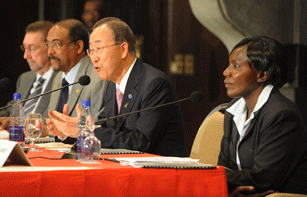
Launch of the Report of the Secretary-General. Nairobi, Kenya, 31 March 2011
In lead-up to June High Level Meeting, progress report presents overview of efforts needed to help countries achieve universal access to HIV services and zero new HIV infections, discrimination and AIDS-related deaths.


(UN Department of Public Information and UNAIDS) Thirty years into the AIDS epidemic, investments in the AIDS response are yielding results, according to a new report released today by United Nations Secretary-General Ban Ki-moon. Titled Uniting for universal access: towards zero new HIV infections, zero discrimination and zero AIDS-related deaths, the report highlights that the global rate of new HIV infections is declining, treatment access is expanding and the world has made significant strides in reducing HIV transmission from mother to child.  


Between 2001 and 2009, the rate of new HIV infections in 33 countries—including 22 in subSaharan Africa—fell by at least 25%. By the end of 2010, more than 6 million people were on antiretroviral treatment in low- and middle-income countries. And for the first time, in 2009, global coverage of services to prevent mother-to-child transmission of HIV exceeded 50%.


But despite the recent achievements, the report underscores that the gains are fragile. For every person who starts antiretroviral treatment, two people become newly infected with HIV. Every day 7 000 people are newly infected, including 1 000 children. Weak national infrastructures,
financing shortfalls and discrimination against vulnerable populations are among the factors that continue to impede access to HIV prevention, treatment, care and support services.


The Secretary-General’s report, based on data submitted by 182 countries, provides five key recommendations that will be reviewed by global leaders at a UN General Assembly High Level Meeting on AIDS, 8–10 June 2011.

After 30 years, war on AIDS at 'moment of truth'

(AFP) With the war on AIDS nearing its 30th anniversary, the UN on Thursday declared "a moment of truth" had come for new strategies to address the campaign's failures and brake costs that were now unsustainable.


"We have a unique opportunity to take stock of the progress and to critically and honestly assess the barriers that keep us shackled to a reality in which the epidemic continues to outpace the response," UN Secretary General Ban Ki-moon said in a report issued in Nairobi.


The 30th anniversary of AIDS is generally recognised as June 5.


It marks the date in 1981 when US epidemiologists reported on mysterious cases of fatal pneumonia among young gays. In 1983, French scientists pinned the cause on a new pathogen, the human immunodeficiency virus (HIV), which destroyed the immune system in heterosexuals and homosexuals alike.

Sunday, March 27, 2011

Closing the gender gap in agriculture: FAO report says invest in female farmers

(Food and Agriculture Organisation of the United Nations) If women in rural areas had the same access to land, technology, financial services, education and markets as men, agricultural production could be increased and the number of hungry people reduced by 100-150 million, FAO said in its 2010-11 edition of The State of Food and Agriculture.

Yields on plots managed by women are lower than those managed by men, the report said. But this is not because women are worse farmers than men. They simply do not have the same access to inputs. If they did, their yields would go up, they would produce more and overall agricultural production would increase, the report said.

"The report makes a powerful business case for promoting gender equality in agriculture," said FAO Director-General Jacques Diouf.

"Gender equality is not just a lofty ideal, it is also crucial for agricultural development and food security. We must promote gender equality and empower women in agriculture to win, sustainably, the fight against hunger and extreme poverty," he added.

Wednesday, March 23, 2011

World Health Organisation releases list of medicines vital for saving mothers and children


Improving maternal and child health is a global priority. An estimated 8.1 million children under the age of five die every year and an estimated 1,000  women – most of them in developing countries – die every day due to complications during pregnancy or childbirth. 

Many of these deaths are due to conditions that could be prevented or treated with access to simple, affordable medicines. However, the availability of medicines at public-health facilities is often poor. 

This  list  of  Priority  Medicines  for  Mothers and Children was developed by the World Health Organization and UNICEF to help countries and partners select and make available those medicines that will have the biggest impact on reducing maternal, newborn and child morbidity and mortality.