Wednesday, June 29, 2011

PROTEST AGAINST BILL H22 OUTLAWING "FGM" IN NIGERIA

Disclaimer: GirlPower! does NOT in any way support the views of this article. GPI Nigeria counts as a major success the passing of the anti-FGM bill, and was one of the NGO's involved in lobbying for it. Comments are very welcome below.


by Nowa Omoigui, MD, MPH, FACC, Columbia, SC, USA. (Edo Nation Online)

I want to state unequivocally that I do not support the proposed HB22 Bill sponsored by Janet Adeyemi and aimed at outlawing "FEMALE GENITAL MUTILATION PRACTICE IN THE FEDERAL REPUBLIC OF NIGERIA."

There is a huge difference between Circumcision and Mutilation. To group all forms of age old religious circumcision into one large category under the guise of medical enlightenment and "civilization" is very unfortunate.

The term "female genital mutilation" is mischievous and hypocritical. Why are we not campaigning to ban "Male Genital Mutilation"? After all, there is a movement of sophisticated gentile physicians led by Dr. George C. Denniston in the US who want male circumcision banned too [Doctors Opposing Circumcision (D.O.C.)]. Let us see who will sponsor that bill in Nigeria-to ban male circumcision-the main indication for which is cultural preference.

Thursday, May 12, 2011

The Social Life of Health: A Pew research

(Pew Internet) "I don’t know, but I can try to find out" is the default setting for people with health questions.
The internet has changed people’s relationships with information. Our data consistently show that doctors, nurses, and other health professionals continue to be the first choice for most people with health concerns, but online resources, including advice from peers, are a significant source of health information in the U.S.

These findings are based on a national telephone survey conducted by Pew Research Center in August and September 2010 among 3,001 adults in the U.S. The complete methodology and results can be found at Pew Internet.

The survey finds that, of the 74% of adults who use the internet:

80% of internet users have looked online for information about any of 15 health topics such as a specific disease or treatment. This translates to 59% of all adults.
34% of internet users, or 25% of adults, have read someone else’s commentary or experience about health or medical issues on an online news group, website, or blog.

Tuesday, April 19, 2011

If Paid Equally, American Women Could Afford 1.7 Years of Food, Rent for 13 Months

(National Partnership) New research shows that the nation’s gender-based wage gap is punishing American families. On average, full-time working women in the United States are paid $10,622 less than their male counterparts, and the gap costs families billions of dollars annually. If the gap were eliminated, Alaskan women could buy 1.7 years’ worth of food. Connecticut’s working women could afford 15 more months of rent. Women in Michigan could make 10 more months of mortgage and utility payments. Californian women could buy 2,100 more gallons of gas.

The research was conducted by the National Partnership for Women & Families, in conjunction with the American Association of University Women (AAUW). The reports span all 50 states and the District of Columbia. The full set is available at www.nationalpartnership.org/epd


"This new data illustrate the very real harm unequal wages are doing to America’s working families,” said Debra L. Ness, president of the National Partnership for Women & Families. “It is long past time to close the gender-based wage gap. With women playing an increasingly important role as family breadwinners, there is no time to waste."

Saturday, April 9, 2011

More about Post-Menopausal Hormone Treatment from Women's Health Initiative


Q. Can you summarize the results of the estrogen-plus-progestin and estrogen-alone studies?
A. Summaries of the findings are given below. However, be aware that the findings for the two studies should not be compared directly because of differences in the women's characteristics at the time of their enrollment in the studies. For example, those in the estrogen-alone study had a higher risk of cardiovascular disease than those in the estrogen-plus-progestin study. Women in the estrogen-alone study were more likely to have such heart disease risk factors as high blood pressure, high blood cholesterol, diabetes, and obesity.

Compared with the placebo, estrogen plus progestin resulted in:
  • Increased risk of heart attack
  • Increased risk of stroke
  • Increased risk of blood clots
  • Increased risk of breast cancer
  • Reduced risk of colorectal cancer
  • Fewer fractures
  • No protection against mild cognitive impairment and increased risk of dementia (study included only women 65 and older)
Compared with the placebo, estrogen alone resulted in:
  • No difference in risk for heart attack
  • Increased risk of stroke
  • Increased risk of blood clots
  • Uncertain effect for breast cancer
  • No difference in risk for colorectal cancer
  • Reduced risk of fracture
  • (Findings about memory and cognitive function are not yet available.)

Saturday, April 2, 2011

UN Secretary-General outlines new recommendations to reach 2015 goals for AIDS response

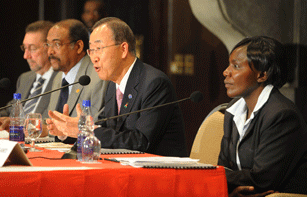
Launch of the Report of the Secretary-General. Nairobi, Kenya, 31 March 2011
In lead-up to June High Level Meeting, progress report presents overview of efforts needed to help countries achieve universal access to HIV services and zero new HIV infections, discrimination and AIDS-related deaths.


(UN Department of Public Information and UNAIDS) Thirty years into the AIDS epidemic, investments in the AIDS response are yielding results, according to a new report released today by United Nations Secretary-General Ban Ki-moon. Titled Uniting for universal access: towards zero new HIV infections, zero discrimination and zero AIDS-related deaths, the report highlights that the global rate of new HIV infections is declining, treatment access is expanding and the world has made significant strides in reducing HIV transmission from mother to child.  


Between 2001 and 2009, the rate of new HIV infections in 33 countries—including 22 in subSaharan Africa—fell by at least 25%. By the end of 2010, more than 6 million people were on antiretroviral treatment in low- and middle-income countries. And for the first time, in 2009, global coverage of services to prevent mother-to-child transmission of HIV exceeded 50%.


But despite the recent achievements, the report underscores that the gains are fragile. For every person who starts antiretroviral treatment, two people become newly infected with HIV. Every day 7 000 people are newly infected, including 1 000 children. Weak national infrastructures,
financing shortfalls and discrimination against vulnerable populations are among the factors that continue to impede access to HIV prevention, treatment, care and support services.


The Secretary-General’s report, based on data submitted by 182 countries, provides five key recommendations that will be reviewed by global leaders at a UN General Assembly High Level Meeting on AIDS, 8–10 June 2011.